iSchools Book Talk

Digital Equity Ecosystems:
How Community Coalitions Reduce Inequality and Strengthen Democracy
presented by Colin Rhinesmith
The Book
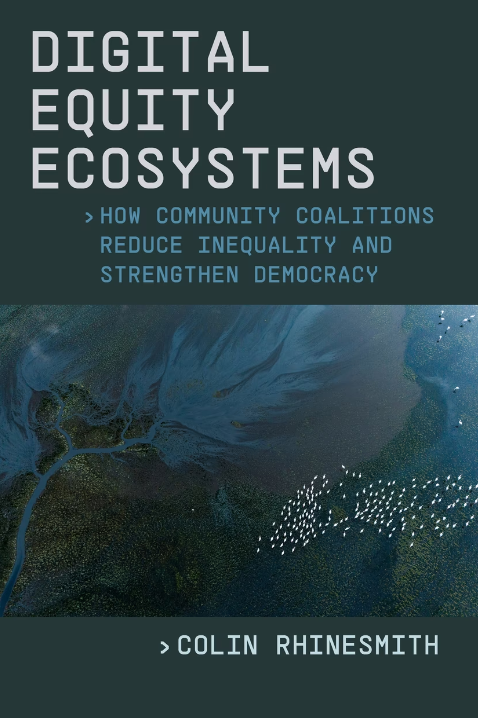
Digital Equity Ecosystems introduces readers to the groundswell of community coalitions that work to alleviate technological inequity and social injustice. Through a comprehensive review of theories and concepts across the fields of information, communication, technology, and public health studies, Colin Rhinesmith reveals how the digital equity ecosystems framework is essential for addressing urgent digital inequalities. Investigating five original case studies of digital equity ecosystems across the United States, Rhinesmith shows how community coalitions serve as vital infrastructure to tackle digital inequality and strengthen democracy. By focusing on these ecosystems as sites for community engagement, civic participation, and social justice organizing, this book helps us make sense of the current moment, arguing that it is crucial to bridge both the digital divide and other social divides more broadly at a time when democracies are in decline worldwide.
The Author

Colin Rhinesmith (he/they) is an associate professor and director of the Digital Equity Action Research (DEAR) Lab in the School of Information Sciences at the University of Illinois Urbana-Champaign. Rhinesmith is a faculty affiliate with the Social & Behavioral Sciences Institute at Illinois, a research fellow with the Quello Center at Michigan State University, and an editor-in-chief of The Journal of Community Informatics. While not thinking about big ideas for his next book, you can find him snuggling his three cats, two dogs, three bearded dragons, and one turtle.
What makes this book special?
Information sciences scholars have used the term “ecosystem” in previous studies referring to sociotechnical analyses of information technology use in community and organizational settings. At the same time, scholars in our field have been critical about using ecological metaphors without attending to the real impacts of technology on our natural world. My book seeks to address this critique directly by describing how digital equity coalitions in regions across the U.S. address digital inequality and social injustice while protecting the environment through technology refurbishing. The book also explains how digital equity ecosystems can raise awareness about social and technological inequality while providing solutions rooted in unique cultural contexts. In other words, this book is unique in that it’s the first in-depth investigation of the role of community coalitions in advancing digital equity. The purpose is to offer a community-level framework for the study of digital inequality, as well as a practical description of how people and organizations can work together to address the root causes of the digital divide, while strengthening democracy at the community-level.
Why should people read this book?
This book is for anyone interested in understanding how to tackle digital inequality while protecting the environment and strengthening local democracy in the process. People organizing in response to data centers should also find this book of particular interest, as “Digital Equity Ecosystems” ultimately offers communities with a roadmap to study, understand, and take greater control of the role of technology in their lives.
What will people learn from this book?
By reading this book, people will gain a deeper understanding of the ongoing problem of digital inequality, the relationship between technology and social injustice, and the impact of technology on our natural world. I hope that readers will also develop a greater awareness not only of these issues, but the practical steps to address these issues working together with others in their communities.
iSchools Book Talk is a new iSchools feature series spotlighting books that members of iSchools would recommend to the iSchools community. These books can be presented either by the authors themselves or by any other iSchools member.
Please contact admin@ischools-inc.org in case you would like to feature a book as well.



Comments