
All iConference 2027 workshops will take place onsite in Wellington, New Zealand. Workshop participation is open to all onsite registrants without extra cost or registration. Please find below an overview of all XX workshops and hover over to find more information and download extra material if available.
Workshop #628
(Re)Enlightening Language and Culture in Information Institutions

Frye, Julie Marie 1; Barker, Maria 2
Rooted in the Enlightenment traditions of inquiry and civic progress, this workshop examines how everyday linguistic practices communicate (or contradict) information organization values. Facilitators present case study findings from a contemporary civic space shaped by both Enlightenment ideals and their historical exclusions: a bilingual (Spanish-English) U.S.-Mexico border library. Facilitators guide participants through structured analysis of the tensions between stated institutional values and linguistic realities. Participants apply thinking routines and participate in collaborative exercises to analyze linguistic contradictions in their organizations, reflect on ways to be (more) linguistically responsive, and foster transparent, authentic information cultures. To sustain momentum beyond the workshop, participants can join a network dedicated to advancing research on transparency, authenticity, and access. This network continues Enlightenment-inspired pursuits of collective inquiry, civic engagement, and inclusive information practices.
Pre-work Invitation: Participants compile institutional materials (e.g., mission statements, website/marketing materials; course materials) for analysis during breakout sessions.
1: Appalachian State University, United States of America; 2: Sam Houston State University, United States of America
Sunday, 29/Mar/2026
1:00pm - 2:30pm
Room 1/119
(Re)Enlightening Language and Culture in Information Institutions

Workshop #691
Translating Disaster Research to Action: Empowering Information Educators with Evidence and Strategies for Community Resiliency

Mardis, Marcia 1; Tu-Keefner, Feili 2 ; Hobbs, April 3; Gomez, Denise 1
Libraries are increasingly called upon to serve as community touch points during disasters. Yet, their staff and their educational experiences lack formal training in crisis leadership, disaster preparedness, and trauma-informed service. This interactive panel convenes LIS researchers, educators, and practitioners to translate disaster research into actionable strategies for the information professions. Drawing on federally funded projects and national consultations, the session will engage participants with evidence-based recommendations for professional learning, innovative curriculum integration, and a dynamic natural crisis leadership research agenda. Participants will experience scenario exercises, collaborative agenda-setting, and frank discussions to identify gaps, share best practices, and co-create priorities for disaster-ready information organizations. Attendees will leave with practical resources, implementation ideas, and opportunities to contribute to a national movement for resilient libraries, accessible in a new digital Community Resiliency Toolkit to support ongoing professional learning.
1: Florida State University, United States of America; 2: University of South Carolina, United States of America; 3: NNLM Region 2, United States of America
Sunday, 29/Mar/2026
3:00pm - 4:30pm
Room 1/119
Translating Disaster Research to Action: Empowering Information Educators with Evidence and Strategies for Community Resiliency
Workshop #802
From Language Proficiency to Learning Gains: promoting effective knowledge sharing among international audiences

Charles, David; Carvalho do Amaral, Janaynne
This workshop draws on experiences planning and delivering professional development workshops for international scholars. Using concrete examples from practice, the workshop examines recurring design and delivery tensions and explores how facilitators adapted workshop structure, engagement strategies, and reflective activities in response to language proficiency. In this workshop, participants will a) gain awareness about the challenges in knowledge sharing, b) design and delivery strategies for varying levels of English proficiency, c) design and delivery strategies for disciplinary and professionally diverse audiences.
University of Illinois at Urbana-Champaign, United States of America
Monday, 30/Mar/2026
8:30am - 10:00am
Room 2/05
From Language Proficiency to Learning Gains: promoting effective knowledge sharing among international audiences
Workshop #785
Fostering a Future-Ready Information Workforce: Understanding the Field’s Needs and Challenges Across Three Empirical Studies

Bergstrom, Tracy; Carroll, Ellen; McBride, Mark; Ruediger, Dylan
Recent surveys and project work at Ithaka S+R have examined how researchers, library professionals, and other academic leaders are adapting to a rapidly changing information ecosystem shaped by the rise of artificial intelligence, advances in digital technology, and emerging best practices for inclusive, accessible, and ethical information stewardship. This work provides valuable insights for iSchools on the evolving competencies and professional capacities needed within the information workforce. Accordingly, this panel will present findings from three 2025 Ithaka S+R studies that highlight how information users and stewards are navigating technological, social, and institutional change. Panelists will discuss the implications of these findings for iSchool curricula, professional development, and the preparation of future leaders across the information and education sectors.
Ithaka S+R, United States of America
Monday, 30/Mar/2026
1:00pm - 2:30pm
Room 2/05
Fostering a Future-Ready Information Workforce: Understanding the Field’s Needs and Challenges Across Three Empirical Studies

Workshop #755
Envisioning Critical Climate Literacy

Martell, Allan 1; Hossain, Khalid 2; Anwar, Misita 3; Markazi, Daniela 4; Nathan, Lisa 5
Climate-related information shapes the ways people understand, care for, and act around the topic of climate change. The ability to find, evaluate, use, and communicate information related to climate change is correlated with communities’ strategies to cope and adapt. Research has shown that anthropogenic climate change has historic roots in social, economic, and technological logics associated with modernity. These logics are embedded in the ways people use and process climate-related information to mitigate the impacts of extreme weather events and cope in case of disasters. The stakes of this area of research are fostering more critically informed and resilient communities and promoting climate justice. This interactive panel seeks to generate dialogue where panelists and the audience explore together how the evolving landscape of information policies, technologies, and infrastructures shapes the information worlds of climate change, and discuss ways to intervene in this space, such as strategies to resist and mitigate the harmful effects of misinformation and disinformation.
1: Indiana University Bloomington, United States of America; 2: Monash University, Australia; 3: Swinburne University of Technology, Australia; 4: University of Illinois Urbana-Champaign; 5: University of British Columbia
Monday, 30/Mar/2026
1:00pm - 2:30pm
Room 1/07
Envisioning Critical Climate Literacy
Workshop #805
Reimagining hopeful futures: Embracing lessons and opportunities from Equity, Inclusion, and Belonging

Archer, Devon 1; Chancellor, Renate 2; Parvin, Nassim 3; Weatherspoon, Hakim 4
This panel critically examines the historical roots and essential roles of equity, inclusion, and belonging (EIB) initiatives in shaping research, teaching, administration, and industry, particularly in light of recent scrutiny and systematic dismantling. Drawing from a range of interdisciplinary perspectives—including information science, organizational studies, social science, and humanities—the session explores the broad consequences of eroding EIB commitments for knowledge production, educational outcomes, labor practices, professional advancement, and community well-being. Panelists will discuss what is at stake when these initiatives are mischaracterized and rolled back, as well as analyze the subsequent epistemic and communal losses and reconfigurations. The session also highlights opportunities in the present moment, featuring innovative programs and initiatives that build on the strengths of the past while inviting new collaborations and possibilities for the future. The session will culminate in a collective agenda in the form of a working paper centered on resilience, solidarity, and structural change.
1: The University of Michigan, United States of America; 2: Syracuse University, United States of America; 3: University of Washington, United States of America; 4: Cornell University, United States of America
Monday, 30/Mar/2026
3:00pm - 4:30pm
Room 1/06
Reimagining hopeful futures: Embracing lessons and opportunities from Equity, Inclusion, and Belonging
Workshop #663
Toward accessible information theories: Crowdsourcing plain language descriptions

Hands, Africa 1; Švab, Katarina 2; Vanscoy, Amy 1; Merčun, Tanja 2
This intellectually engaging and creative workshop focuses on making information science theories more accessible for students and research participants. Come learn about our research project where we developed plain language descriptions of twelve classic information behaviour theories. We will discuss the challenges of making theory accessible to non-research audiences, and you will try your hand at creating plain language descriptions of theories through a crowdsourcing exercise with fellow workshop attendees. If you want to geek out about theory, have fun with other conference attendees, and come away with some useful ideas for your research and teaching, this workshop is for you!
1: University at Buffalo, United States of America; 2: University of Ljubljana
Tuesday 31/Mar/2026
8:30am - 10:00am
Room 1/06
Toward accessible information theories: Crowdsourcing plain language descriptions
Workshop #114
Practical and Philosophical Approaches to Information Evaluation in an Age of Post-Truth and AI

Saunders, Laura 1; Budd, John 2; Gorichanaz, Timothy 3
The panel will explore several approaches for teaching evaluation of information, including: how intellectual humility could position learners to consider different perspectives and update their opinions and beliefs; how “truth claims” can be verified from the standpoint of the objectivity of truth and of intellectual integrity; the evolving nature of facts; and an overview of existing research on the effectiveness of two approaches to evaluating fact-based information: lateral reading and probabilistic judgments, and how these approaches could inform library instruction and the preparation of librarians who will provide such instruction. An open discussion will follow.
1: Simmons University, United States of America; 2: University of Missouri, USA; 3: Drexel University, USA
Tuesday 31/Mar/2026
1:00pm - 2:30pm
Room 1/06
Practical and Philosophical Approaches to Information Evaluation in an Age of Post-Truth and AI
Workshop #767
Documents in the Age of AI: What does the concept of documents offer in an LLM-saturated world?

Østerlund, Carsten 1; Donner, Sascha 2; Shankar, Kalpana 3; Erickson, Ingrid 1; Kausch, John 4
From cave paintings to papyrus to data bases, documents have long materialized meaning and coordinated collective life. Today, generative AI floods us with text and reframes the “document” from fixed artifact to co-produced process. This shift strains norms of citation, provenance, accountability, and testimonial trust, while demanding new practices: disclosure of AI involvement, richer process metadata, and reproducibility protocols for stochastic outputs. It also reshapes how we write, search and read, raising risks of bias, discrimination, and hallucination. This panel brings together scholars of documentation, qualitative and quantitative scholars, and practitioners to ask: What does the concept of the document still buy us in an LLM-saturated world? Should assessment move from static artifacts and data to process-oriented evaluations of human–AI meaning-making? How do new forms of documents carry institutional structures and reveal organizational work? Bridging LIS, CSCW, and data-intensive research, we map emerging development, methods and governance for accountable, sustainable documentation in the age of AI.
1: Syracuse University, United States of America; 2: Humboldt-Universität zu Berlin, Germany; 3: University College Dublin, Ireland; 4: Western University of Ontario, Canada
Tuesday 31/Mar/2026
3:00pm - 4:30pm
Room 1/06
Documents in the Age of AI: What does the concept of documents offer in an LLM-saturated world?
Workshop #788
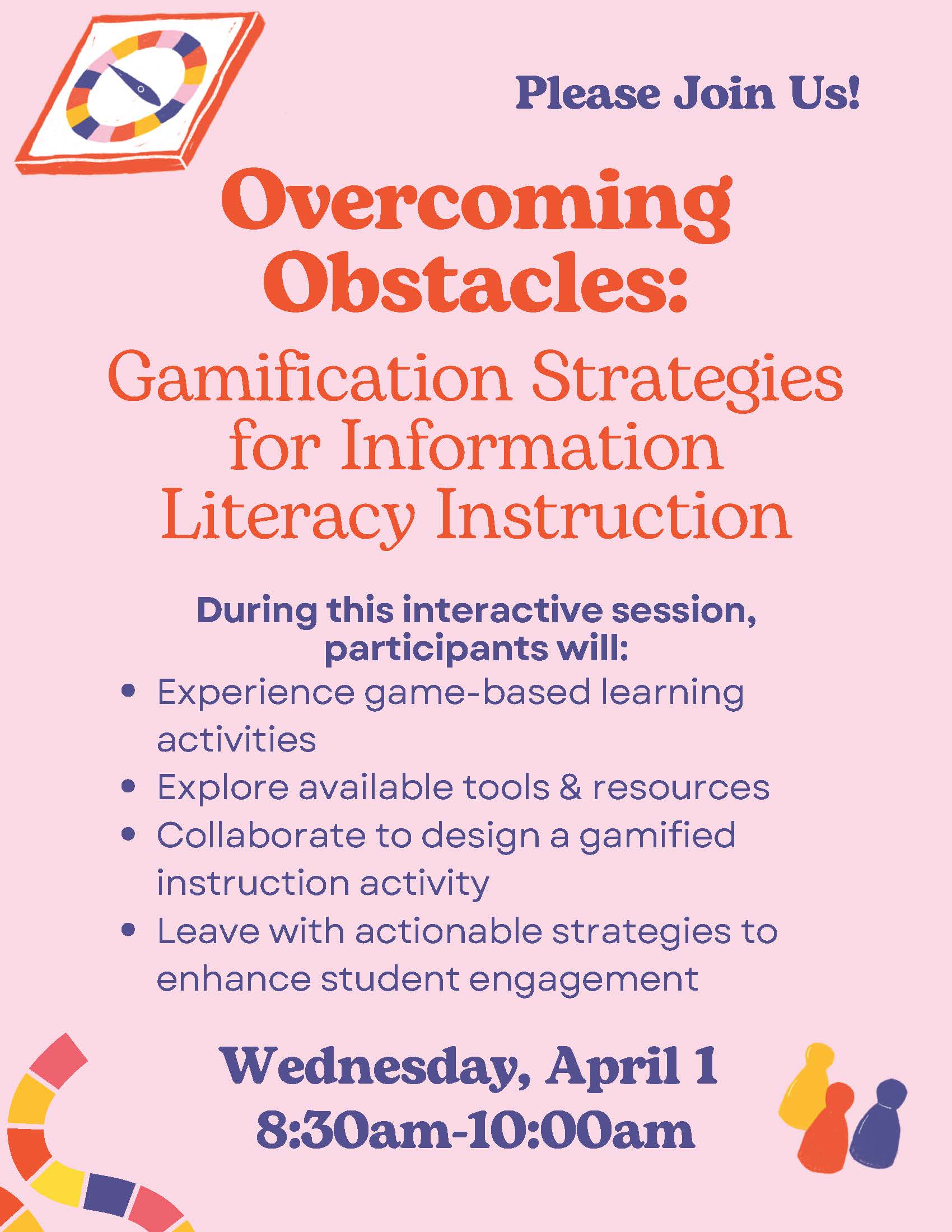
Overcoming Obstacles: Gamification Strategies for Information Literacy Instruction

Whitney, Rachel 1; Andresen, Christine 1; Walden, Rachel 2;
With instant access to unlimited information at our fingertips, facts are often obscured by misinformation, making it challenging to find evidence-based answers. Library and information science faculty play a crucial role in teaching students how to find and use credible sources, a lifelong literacy skill of increasing importance in the age of artificial intelligence. One strategy used to engage students is game-based learning, which intersects game elements within the education environment to increase satisfaction and improve learning outcomes. Game-based learning activities often incorporate complex digital tools, but technology is not required to create a successful gamified learning experience. Freely available activities requiring little or no technology can still positively impact learning outcomes and facilitate critical thinking. Without guidance on steps for practical implementation, faculty may struggle through the trial-and-error process of creating engaging instruction experiences. This session aims to remove barriers and support faculty developing and implementing game-based learning activities.
1: Medical University of South Carolina, United States of America; 2: Vanderbilt University, United States of America
Wednesday, 1/Apr/2026
8:30am - 10:00am
Room 1/06
Overcoming Obstacles: Gamification Strategies for Information Literacy Instruction
Workshop #782
Digital Preservation: A Critical Vocabulary

Frank, Rebecca D. 1; Acker, Amelia 2; Bettivia, Rhiannon 3; Cushing, Amber 4; Johnston, Jesse 1; Kriesberg, Adam 3; Polasek, Katherine 1; Shankar, Kalpana 4
This panel brings together contributors to the forthcoming MIT Press volume "Digital Preservation: A Critical Vocabulary" to explore how fundamental preservation concepts carry different meanings across disciplines. Terms like "authenticity," "record," and "risk" mean different things to scholars and practitioners in archival science, computer science, engineering, and management, for example. Through examining these varied interpretations, panelists will identify and discuss assumptions embedded in digital preservation standards and discourse that affect what gets preserved, how preservation work is conducted, and who will have access to digital information in the future.
A preprint of the edited volume can be found here: https://digital-preservation-a-critical-vocabulary.pubpub.org/dash/overview
1: University of Michigan, United States of America; 2: Rutgers University, United States of America; 3: Simmons University, United States of America; 4: University College Dublin, Ireland
Wednesday, 1/Apr/2026
1:00pm - 2:30pm
Room 2/05
Digital Preservation: A Critical Vocabulary
Workshop #708
North–South Dialogues for an Equitable and Sustainable Information Future

Yan, Pu 1; Zhang, Jiuzhen 1; Vlachidis, Andreas 2; Zhou, Wenjie 3
This panel examines how the information ecologies between the Global North and South shape the pursuit of an equitable and sustainable information future. Drawing on three research frontiers—climate communication, information poverty, and AI ethics—the panel highlights comparative and reflexive perspectives on knowledge flows, data asymmetries, and epistemic justice. Through case studies spanning China, India, the UK, and Switzerland, participants will explore how algorithmic systems, digital infrastructures, and policy regimes mediate access to information and participation in global knowledge production. By fostering North–South dialogues among scholars, practitioners, and policymakers, this panel seeks to inspire new frameworks and collaborations for building inclusive information societies in the age of AI.
1: Peking University, People's Republic of China; 2: University College London, UK; 3: Renmin University
Wednesday, 1/Apr/2026
3:00pm - 4:30pm
Room 1/06
North–South Dialogues for an Equitable and Sustainable Information Future
Workshop #626
Cooperation & Collaboration: How Can Early-Career Researchers Carry Out International Studies?

Wang, Di 1; Anwar, Misita 2; Seadle, Michael 3; Oliver, Gillian 4; Chowdhury, Gobinda 5; Truong, Vi 6; Ito, Hiroyoshi 7
In today’s globalized academic landscape, international collaboration is essential for advancing knowledge, innovation, and inclusiveness. Organized by the Asia-Pacific iSchools Next Generation Committee, this panel will explore strategies and mechanisms that empower early-career researchers (ECRs) to engage in meaningful international studies. Senior scholars with leadership experience in international research organizations will share strategic insights, while ECRs with hands-on collaboration experience will provide practical guidance. Interactive activities, including open discussions, breakout discussions, and scenario-based polls, will encourage audience participation. The panel aims to identify effective practices, address barriers, and propose actionable recommendations for supporting ECRs’ international engagement. Aligned with the iConference 2026 theme “Information Literacies, Authenticity and Use: The Move Towards a Digitally Enlightened Society”, this panel highlights how global collaboration enhances digital literacy, intercultural competence, and authentic knowledge exchange within the iSchools community.
1: Renmin University of China, China, People's Republic of; 2: Swinburne University of Technology, Australia; 3: Humboldt-Universität zu Berli, Germany; 4: Monash University, Australia; 5: University of Strathclyde, UK; 6: University of Melbourne, Australia; 7: University of Tsukuba, Japan
Wednesday, 1/Apr/2026
Part I: 3:00pm - 4:30pm; Part II 5:00pm - 6:00pm
Room 2/10
Cooperation & Collaboration: How Can Early-Career Researchers Carry Out International Studies?
Workshop #741
Beyond Detection: Teaching Authenticity in the Age of AI

Makhafola, Lesego; Holmer, Marlene; VAN WYK, Brenda
Generative AI has amplified access to writing, coding, analysis, and to academic misconduct. The panel will examine how information and digital literacies must evolve amid ubiquitous AI tools, with a special focus on academic integrity and ghostwriting in teaching, learning, and research. Bringing together scholars in information literacy, learning analytics, AI ethics, and writing support, the panel will: (1) map the current landscape of AI-assisted academic authorship; (2) interrogate the limits of detection and “AI-free” mandates; (3) present pragmatic literacy frameworks and assessment redesigns; and (4) debate institutional responses to ghostwriting, contract cheating, and assistive AI. A structured audience “mini-lab” will bring forth institutional policies, equity considerations, and disciplinary differences. Deliverables include an open toolkit (rubrics, syllabus language, and a policy decision matrix) and a community bibliography to sustain campus-wide dialogue beyond the event.
University of Pretoria, South Africa
Thursday, 2/Apr/2026
8:30pm - 10:00pm
Room 1/07
Beyond Detection: Teaching Authenticity in the Age of AI
Workshop #660
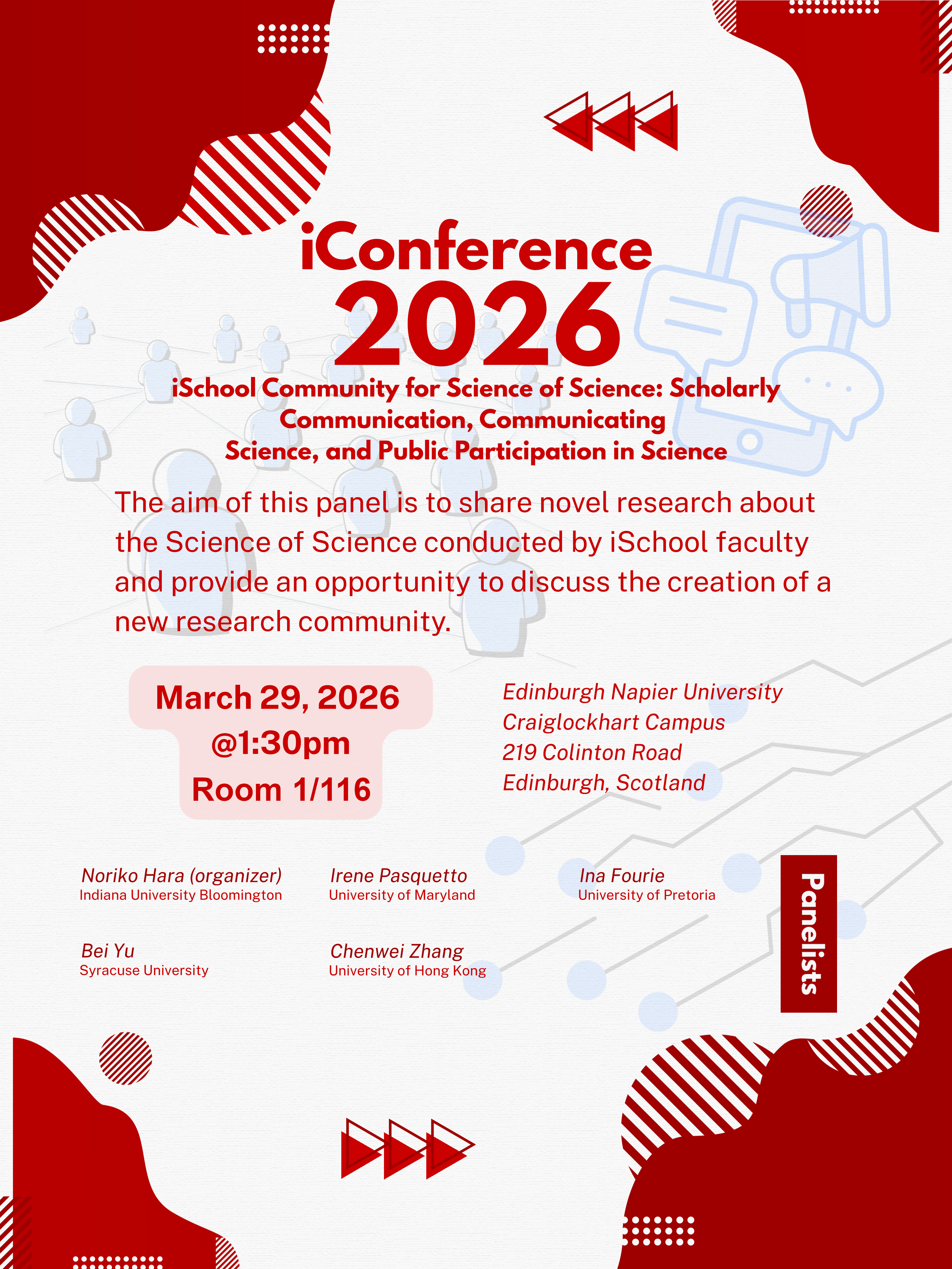
iSchool Community for Science of Science: Scholarly Communication, Communicating Science, and Public Participation in Science

Hara, Noriko 1; Yu, Bei 2; Pasquetto, Irelene 3; Zhang, Chenwei 4; Fourie, Ina 5
Scholarly communication is a common research thread in the iSchool community. However, studies about communicating science outside of academic circles within “Science of Science” research is not as mainstream. Information about science is quickly becoming easier for the non-expert public to obtain, circulate, and co-produce. On one hand, prevalent online communication platforms, such as social media, offer resources for citizens seeking concise explanations of complex scientific issues. On the other hand, widespread misinformation online is a major issue for the non-expert public’s attempts to gain relevant scientific knowledge. These online platforms create both opportunities and challenges for scientists and the public when they interact with each other. The aim of this panel is not only to share novel research about the Science of Science conducted by iSchool faculty but also to provide an opportunity to discuss the creation of a new research community.
1: Indiana University Bloomington, United States of America; 2: Syracuse University, United States of America; 3: University of Maryland, United States of America; 4: University of Hong Kong; 5: University of Pretoria
Sunday, 29/Mar/2026
1:00pm - 2:30pm
Room 1/116
iSchool Community for Science of Science: Scholarly Communication, Communicating Science, and Public Participation in Science
Workshop #692
Community-Embedded Artificial Intelligence Literacies: Critical Frameworks of Research, Praxis, and Authentic Impact

Mehra, Bharat 1; Tribelhorn, Sarah 2; Lu, Kun 1; Hofman, Darra 3; Ghosh, Souvick 3
This panel includes diverse voices that explore different models, frameworks, practices/praxis, research, and solutions to address current gaps around the “how-to’s” of tailoring community-embedded design, development, and use of relevant and meaningful artificial intelligence (AI) to local/regional needs and expectations. The select group of critical scholars in the panel raise legitimate concerns around the uncheck¬ed growth of AI without adequate assessment of its intertwining social, cultural, economic, and political ramifications in a neoliberal global networked information society. The goal is to initiate discussion around authentic community-embedded AI literacies to develop supporting digital, social, and human-centered infrastructures that are representative/integral to local/regional contexts and needs. This session provides an opportunity of pluralistic learning and engagement for the audience from panelists’ presentations and complementary small-group discussions.
1: University of Alabama, United States of America; 2: San Diego State University, United States of America; 3: San Jose State University, United States of America
Sunday, 29/Mar/2026
3:00pm - 4:30pm
Room 1/116
Community-Embedded Artificial Intelligence Literacies: Critical Frameworks of Research, Praxis, and Authentic Impact
Workshop #596
AI, Cybersecurity, and Digital Literacy Through Cybersecurity Clinics

Wagner, Paul; Honomichl, Robert; Hu, Xiao
Cybersecurity clinics represent a transformative model for experiential learning and community engagement, enabling students to deliver cybersecurity and digital literacy support to nonprofits, small businesses, schools, and municipalities. This interactive workshop explores how clinics can advance three critical priorities for the iSchools community: Artificial Intelligence (AI), cybersecurity, and digital literacy. Participants will collaborate with peers to design strategies for integrating AI readiness, cybersecurity capacity-building, and equity-focused digital literacy into clinic models. The session will combine short framing presentations with group brainstorming, collaborative case study analysis, and the co-creation of a shared resource repository. By working together, participants will identify best practices, pedagogical frameworks, and research opportunities. The workshop will equip attendees with actionable strategies for launching or enhancing cybersecurity clinics in their institutions and communities, while contributing to a collective agenda for advancing digital resilience through iSchool-led innovation.
University of Arizona, United States of America
Monday, 30/Mar/2026
08:30am - 10:00pm
Room 1/06
AI, Cybersecurity, and Digital Literacy Through Cybersecurity Clinics
Workshop #169
Be It Resolved: Engaging with Theory in Information Science is Unnecessary

Huvila, Isto 1; Julien, Heidi 2; Olsson, Michael 1; Ruthven, Ian 3
Theory use is associated with scholarly rigor but many of the significant outcomes of Information Science research have been non-theoretical. So does theory matter? In Information Science, theory use has been analyzed, promoted, and debated, making this aspect of the research enterprise an ongoing concern and focus of discussion. This panel will take the form of a debate, arguing for and against the necessity of engagement with theory in Information Science scholarship, providing the audience with an opportunity to consider the potential value of theory to inform development of research questions, methodological approaches, and interpretation of empirical data. The audience will hear from senior scholars in the field with strong interest in theory and will also be encouraged to join the debate and think about the ways in which their own scholarship has engaged theory or has the potential to do so.
1: Uppsala University, Sweden; 2: University at Buffalo, United States of America; 3: University of Strathclyde, Scotland
Monday, 30/Mar/2026
1:00pm - 2:30pm
Room 1/06
Be It Resolved: Engaging with Theory in Information Science is Unnecessary
Workshop #637
Libraries Reimagined: Shaping an Enlightened, Inclusive, and Digital Society

Du, Jia Tina 1; Chou, Charlene 2; Zhou, Lihong 3; Hong, Lingzi 4
Libraries are not merely adapting to technological change; they stand at a pivotal crossroads where their foundational values of access, equity, and trust must be integrated with emerging digital capabilities. This panel recognises that today’s technological era represents a fundamental shift for information professionals, requiring more than a surface response to digital transformation. It explores the evolving role of libraries in an age defined by generative AI and rapid technological acceleration, asking how libraries can harness these tools to advance reason, education, and civic progress while promoting more inclusive and diverse ways of knowing. Through dialogue between scholars and practitioners, the panel will consider how libraries can become truly AI-ready, inclusive, and indispensable public institutions, ensuring that digital innovation and AI uphold authenticity, trust, and equity in building a more enlightened and inclusive society.
1: Charles Sturt University, Australia; 2: New York University; 3: Wuhan University; 4: University of North Texas
Monday, 30/Mar/2026
3:00pm - 4:30pm
Room 2/05
Libraries Reimagined: Shaping an Enlightened, Inclusive, and Digital Society
Workshop #823
Lifelong AI Literacies and the Ethics of Reskilling: Preparing Graduates for Evolving Futures in Workforce 5.0

Holmner, Marlene 1; Bothma, Theo 1; Rorissa, Abebe 2; Campbell-Meier, Jennifer 3
Artificial Intelligence (AI) is transforming work in profound ways, while demographic shifts signal that graduates today may navigate century-long careers as life expectancy rises well beyond 100 years (Stanford Center on Longevity, 2021; IHME, 2023). This convergence demands a rethinking of education in the era of Workforce 5.0, where human–AI collaboration must remain ethically grounded and human-centered. This panel, “Lifelong AI Literacies and the Ethics of Reskilling: Preparing Graduates for a 100-Year Career in Workforce 5.0”, explores how higher education can embed lifelong AI literacies that extend beyond technical skills to include ethical reasoning, socio-technical awareness, and critical data literacy. It considers the ethical dilemmas of continuous reskilling, the contrasting challenges and innovations across the Global North and South, and strategies for designing adaptive curricula to prepare graduates for multiple cycles of reinvention. By integrating diverse perspectives, the panel invites dialogue on ensuring human dignity, equity, and resilience in long working lives shaped by AI.
1: University of Pretoria, South Africa; 2: The University of Tennessee, Knoxville; 3: Victoria University of Wellington, New Zealand
Tuesday 31/Mar/2026
8:30am - 10:00am
Room 2/05
Lifelong AI Literacies and the Ethics of Reskilling: Preparing Graduates for Evolving Futures in Workforce 5.0
Workshop #726
Keepers of the stories: participatory engagement in library and information science

Salzano, Rachel; Brazier, David; Wilson, Marianne; Feeney, Drew
Participatory research has been applied to several domains across academia and the private and public sectors. Although sometimes overlooked due to its demanding nature, participative methodologies are particularly suited for work in galleries, libraries, archives, and museums (GLAM). The proposed workshop will introduce attendees to the principles of participatory research through the lens of storytelling. Group activities will encourage attendees to consider how they might enact participatory engagement in their current roles. Attendees will have the opportunity to both facilitate and act as a participant in the initial stages of a participatory project. This workshop will enable attendees to have a holistic view of participatory processes as well as ideas around how these would work and be impactful within their own contexts.
Edinburgh Napier University, United Kingdom
Tuesday 31/Mar/2026
Part I 1:00pm - 2:30pm; Part II 3:00pm - 4:30pm
Room 2/05
Keepers of the stories: participatory engagement in library and information science
Workshop #646
Equity and Access in Information Education: Building Global Pathways for Emerging and Diasporic Communities

Abokor, Awo 1; Donaldson, Devan 2; Pearcy, Agnes 3, Mostafa, Javed 1
Access to education in information science remains uneven globally, especially for students from emerging and developing countries and for diasporic communities facing migration and displacement. These populations often confront economic barriers, political exclusion, limited institutional resources, and curricula that do not reflect their cultural backgrounds. A primary area of focus for the panel-anchored interactive session is diversifying at the level of recruitment and developing strategies for attracting diverse students. This panel will bring together case studies such as HBCU-iSchool partnerships in the U.S., archival work preserving marginalized histories, and international open data initiatives bridging the Global North and South to explore how iSchools can incorporate social justice, overcome systematic inequalities, design equitable data infrastructures and culturally relevant curricula in information education. Some strategies for addressing diversification will include:
• Building mentorship pipelines between undergraduate and graduate LIS programs (like i3–Spectrum pipeline concept).
• Leveraging open educational resources and virtual mobility programs for global access.
• Using data ethics and quality frameworks to empower underrepresented researchers.
1: Faculty of Information, UofT; 2: Indiana University, Bloomington; 3: North Carolina Central University
Tuesday 31/Mar/2026
1:00pm - 2:30pm
Room 1/07
Equity and Access in Information Education: Building Global Pathways for Emerging and Diasporic Communities
Workshop #761
Arts & Information Science: Projects and Provocations

Daly, Diana 1; Kampen, Andrea 2; Wagner, Travis 3; Noone, Rebecca 4; Penrose, Rebecca 5; Salzano, Rachel 6;
This panel offers perspectives from researchers, artists, and professionals on working with the arts at iSchools and in Information Science (IS), including arts-based inquiry, research on arts events and artists, and using artistic methods for reporting results. Panelists have worked on numerous arts-related projects, including arts-based autoethnography, the use of obsolete formats to recontextualize media as an artistic practice, arts encounters in librarianship, analysis of arts events as archives, and interrogations of performance with and without AI assistance. Panelists will present overviews of their projects intertwined with the arts, and then offer “provocations” in the form of big questions about the arts in IS for fellow panelists and the audience. Concurrent with these activities, collaborative, sequential creation activities will circulate among audience members for lateral, hands-on engagement. Among the goals of this event is building community among information scientists and practitioners working with the arts.
1: University of Arizona; 2: Univeristy of British Columbia; 3: University of Illinois Urbana-Champaign; 4: University of Glasgow; 5: California State University; 6: Edinburgh Napier University
Wednesday, 1/Apr/2026
8:30am - 10:00am
Room 2/05
Arts & Information Science: Projects and Provocations
Workshop #636
Recordkeeping for the People, by the People: What Would it Look Like?

Oliver, Gillian 1; Foscarini, Fiorella 3; Jeurgens, Charles 4; Haraldsdottir, Ragna 2;
Organisational functions and the imperative to create and maintain records that support accountability and evidentiality are at the forefront in the design of recordkeeping systems. The purpose of this workshop is to challenge that organization-centred approach and take a radically different perspective, exploring what person-centred recordkeeping would look like. In other words, what would organisational records and recordkeeping look like if the people who are the subjects of records, for instance adults or young people receiving government assistance, were prioritised in the design of recordkeeping systems? We will consider what records could be created and who would have decision-making powers about access, ownership and retention.
1: Monash University, Australia; 2: University of Iceland; 3: University of Toronto; 4: University of Amsterdam
Wednesday, 1/Apr/2026
8:30am - 10:00am
Room 1/07
Recordkeeping for the People, by the People: What Would it Look Like?
Workshop #784
Critical literacy and censorship: the power of reading

Oltmann, Shannon 1; Knox, Emily 2; Cooke, Nicole 3;
This panel will discuss the state of critical literacy across multiple nations, in light of the ongoing rise in book bans. We describe the background and context for book bans since 2020, using the U.S. and Australia as examples; we also introduce critical literacy and explain how it is diminished through book bans. Only with a wide range of perspectives available will critical literacy be a fruitful endeavor. Four panelists will present their diverse views, then engage in robust discussion with the audience based on several provocative questions we will pose.
1: Wayne State University, United States of America; 2: University of Illinois, United States of America; 3: University of South Carolina, United States of America
Wednesday, 1/Apr/2026
3:00pm - 4:30pm
Room 2/05
Critical literacy and censorship: the power of reading
Workshop #737
Synergizing Minds and Machines: Human-AI Collaboration in Knowledge Work through an Information Science Lens

Dedema, Meredith 1; Ma, Rongqian 1; Zhang, Pengyi 2; Jarrahi, Mohammad Hossein 3; Østerlund, Carsten 4
As artificial intelligence (AI) continues to play an increasingly pivotal role in shaping modern knowledge work, it becomes essential to explore how humans and AI systems can collaborate effectively to enhance decision-making, creativity, and productivity. From an information science (IS) perspective, this shift invites critical inquiry into the dynamics of human-AI collaboration in knowledge work, where the complementary strengths of human intuition, contextual expertise, and ethical judgment intersect with AI’s capacity to process vast datasets, identify patterns, and augment cognitive tasks. This panel seeks to unravel how such partnerships reshape knowledge workflows, asking: How do humans and AI co-construct and validate knowledge in collaborative settings? By examining socio-technical interactions through lenses such as human-AI symbiosis, collaborative sense-making, knowledge management, and co-intelligence, this panel aims to examine how AI tools are integrated into knowledge work environments, focusing on their ability to augment human expertise, manage vast amounts of data, and support complex problem-solving tasks, and uncover the challenges and ethical issues presented by human-AI partnerships, including accuracy, transparency, and trust. Ultimately, understanding human-AI collaboration through the lens of IS offers critical insights into advancing a framework where machines and minds not only coexist but also thrive as interdependent actors in the evolving landscape of knowledge work.
1: Indiana University Bloomington; 2: Peking University; 3: University of North Carolina at Chapel Hill; 4: Syracuse University
Wednesday, 1/Apr/2026
3:00pm - 4:30pm
Room 1/07
Synergizing Minds and Machines: Human-AI Collaboration in Knowledge Work through an Information Science Lens
Workshop #828
Beyond Definitions: Exploring Literacy and Competency in Information Science

Ryan, Frances; Brazier, David; Goddard, Callum
This 90-minute workshop critically examines the conceptual and practical boundaries between “literacy” and “competency” within Information Science. Recognizing the variability of these constructs across research, education, and professional practice, the session offers a structured, interactive space for participants to explore their intersections and distinctions. The aim is to co-create strategies for more inclusive, authentic, and context-sensitive approaches, as well as identifying gaps in existing approaches and seeking a consensus on future directions and challenges we face.
* This workshop is most suitable for those currently working or researching in the areas of literacy and competency.
* Participants have the option of sharing their views on the topic. This can include case studies, examples or constructive position statements at the start of the workshop. If you wish to be considered for this, please send your proposal via this link: https://forms.cloud.microsoft/e/52U0HMP3L5 (Deadline: 28 February 2026)
* Throughout the workshop, we will be working on creating conceptual mappings and fostering discussion surrounding these as well as identifying gaps and future directions for the field of literacy and competency. It is expected that participants will have a foundational understanding of the concepts ahead of the session.
* The end goal is to create conceptual mappings, strategic frameworks, and a shared report to support ongoing collaboration and innovation in information literacy and competency development. We welcome ongoing conversations and networking around these issues after the conference.
Edinburgh Napier University, United Kingdom
Thursday, 2/Apr/2026
8:30am - 10:00am
Room 2/05
Beyond Definitions: Exploring Literacy and Competency in Information Science
Workshop #764
Illuminating the Future: Lessons Learned from Generative AI in Academia’s Drive Toward a Digitally Enlightened Society

VAN WYK, Dr Brenda 1; Campbell-Meier, Jennifer 2; Du, Tina Jia 3; Holmner, Marlene 1; Penrose, Rebecca 4
This panel explores key lessons learnt on the use of generative artificial intelligence (GenAI) tools in academic, research and information literacy practices. The need for human oversight, ensuring analytical precision and rigour in academic research workflows and processes, has become increasingly vital. Navigating these intricacies of human-machine interactions must be supported by information literacy programmes via hands-on AI literacy training. GenAI holds great promise for personalised feedback, tailored learning practices and customised instructions but should not displace creativity, empathy and critical thinking. Trust, honesty and ethical conduct form the basis for academic integrity. This should be supported by clear, transparent AI policies and frameworks. Ultimately, robust infrastructures and equitable access to GenAI tools must be nurtured to collectively build inclusive AI knowledge societies, crossing divides and democratising opportunities. Harnessing these lessons learnt, this panel heeds the call of iConference2026 to develop inclusive, responsive and critical literacies for digitally enlightened societies.
1: University of Pretoria, South Africa; 2: Victoria University of Wellington, New Zealand; 3: Charles Strut University, Australia; 4: California State University, Bakersfield
Thursday, 2/Apr/2026
10:30am - 12:00pm
Room 2/05
Illuminating the Future: Lessons Learned from Generative AI in Academia’s Drive Toward a Digitally Enlightened Society